Most companies think they have a communication problem, but what they actually have is an authenticity problem.
According to a 2024 study by USC Annenberg School for Communication and Journalism and Staffbase, fewer than one in three employees are very satisfied with the quality and amount of internal communication they receive. Meanwhile, 80% of leaders believe their internal communications are clear and engaging, while only 50% of employees agree.
The gap is not in the volume of communication, but in its texture. What most internal comms lack is the kind of honest, unguarded human quality that actually makes people feel known.
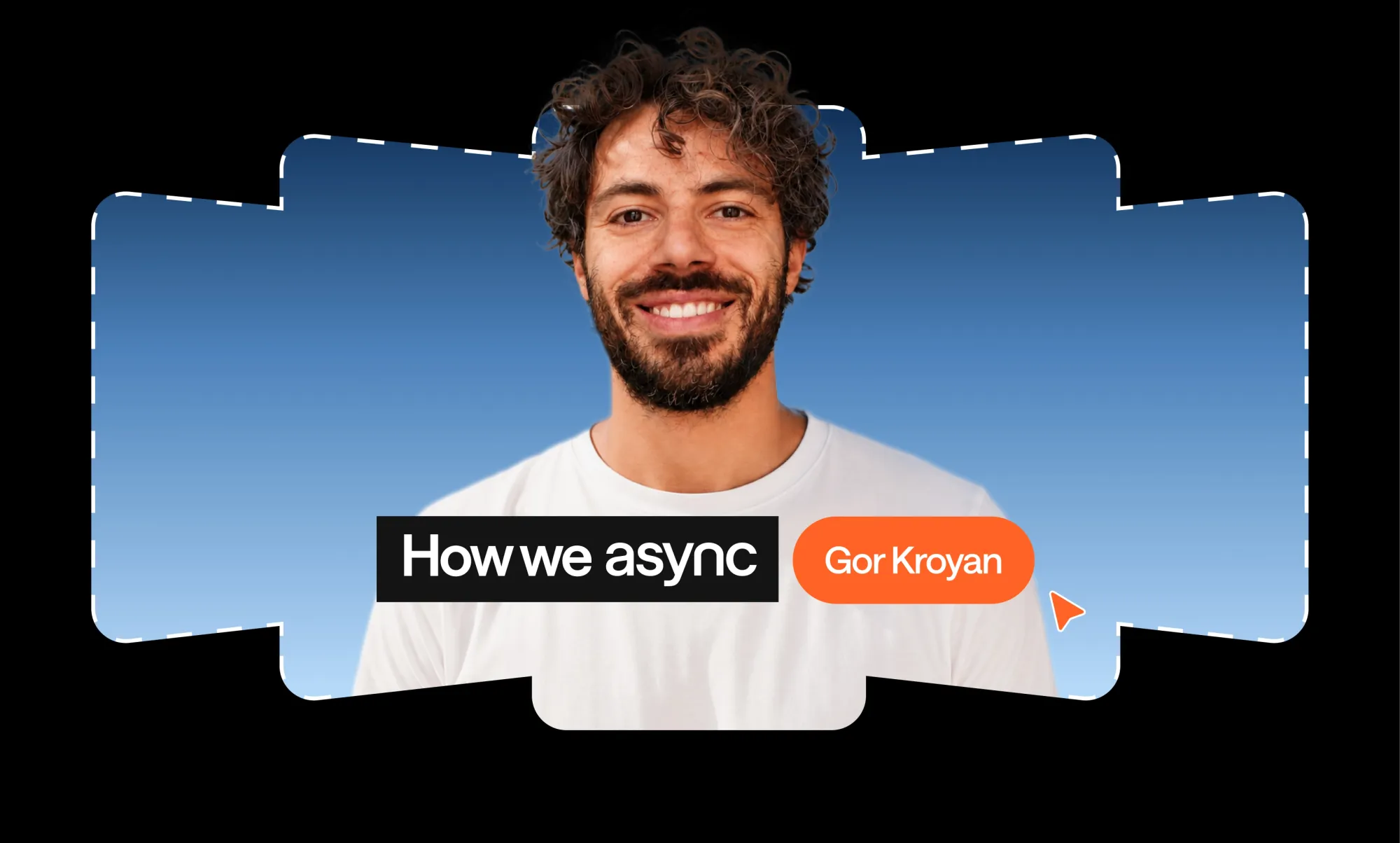
Gor Kroyan, our Product Manager at Async, decided to close that gap in an unusual way. He started an internal podcast. Not a leadership broadcast or a company update, but a podcast about people, recorded using Async, the very tool our team built.
What followed became one of the more instructive case studies in what genuinely human internal communication can do for a team.
Your team communicates constantly. So why does no one feel known?
Before understanding what the Async podcast accomplished, it helps to understand what it was responding to. The dominant modes of internal communication, Slack messages, email threads, formal 1:1s, all-hands presentations, are built for efficiency, not intimacy. They are designed to transmit information, but not to reveal the person behind the job title.
Research consistently shows the cost of this. Gallup’s State of the Global Workplace 2024 Report found that only 23% of employees globally are classified as engaged. The Institute of Internal Communication’s 2024 IC Index, which surveyed 4,000 UK-based employees, found that where workers rated internal communication as excellent, there was a 40-point boost in engagement, but excellent, evidently, is rare. The same research underlines that what employees respond to is not more communication but more authentic communication: a strategic narrative or a feeling that they are seen as individuals rather than headcount.
What Gor observed at Async was subtler than disengagement, but pointing in the same direction. “The authenticity of that particular employee,” he explains, “is what was missing. Things are totally different when you are doing a 1:1 and they need to tell about themselves.” Formal settings, even friendly ones, produce a version of people, not the full picture.
Why a podcast, and why video
The decision to use a podcast format, specifically video, was deliberate. In an era where written communication has become increasingly templated and largely indistinguishable from AI-generated output, the human voice carries a different weight.
Listeners can discern authenticity through tone of voice, making podcasts an ideal medium for conveying sincerity and genuine intent in ways that text simply cannot replicate. Edison Research found that 74% of podcast listeners tune in to learn new things, and when the subject is a colleague, that curiosity comes naturally.
Gor was explicit about this reasoning. “It was video, which adds soul,” he says. “The person’s voice is something you already recognize from the office. But now they are telling you something different, something interesting, what book they love, what they do when they are alone. And all of that with their own voice, not text that can be generated these days.” The format created a layer of human signal that no written medium could reproduce.
The structural choices reinforced the intent. Episodes were recorded after office hours, from home environments. That seemingly minor detail mattered enormously. “The home environment adds up to comfortability,” Gor notes, “and it would make others want to participate, because speaking up about their true self was an exciting thing.” Removing the professional context removed the professional armor.
What the podcast was actually for
Here is where the thinking becomes genuinely interesting from a product and leadership perspective. Gor did not build this podcast purely as a culture initiative. He built it as an empathy exercise.
“The core idea is to feel what our users go through,” he explains. “To see real pain and have empathy towards them.” Async is a tool built for asynchronous communication, and its team works with it daily. By using Async to produce, edit, and distribute the podcast, recording in the studio, editing in the platform, sharing episodes via Slack, the PM was doing something unusual: designing an internal experience that doubled as user research. Every friction point in the workflow was a data point. Every moment where the tool felt intuitive was a confirmation.
This dual purpose is worth dwelling on. The podcast was simultaneously an exercise in culture-building and in product empathy, a way of stress-testing Async’s own capabilities while building the kind of human connection that makes a team more than a collection of contributors. The editing workflow in particular proved its value quickly. “I imagine if there were no editor inside Async it would be a nightmare,” Gor says plainly.
Quality and ease of production were not peripheral. They determined whether the project could be sustained at all.
The numbers that proved it was working
Async has 56 employees. The first episode of the podcast generated 200 views. The arithmetic tells the story: people were watching more than once, sharing episodes within the company, and using phrases and references from the episodes in day-to-day conversations. “People would use phrases from the episode or poke the person,” Gor recalls. The content had become a shared language.
The guest pipeline required no editorial management. “After the very first episode, there were folks reaching out saying, when is my turn?” The demand was entirely organic, which is the truest possible validation that a format has landed. No one was nudged to participate. People wanted to because they had seen what it looked like for a colleague to be genuinely seen, and they wanted that for themselves.
What made the conversations actually good
If there is one pattern that emerged consistently across every episode, it is that the best moments had nothing to do with work. Gor found that questions about hobbies consistently unlocked something in people that professional conversations rarely reach. Not because hobbies are trivial, but because they are chosen. They reveal what a person values when no one is asking them to perform.
“When I was asking everyone about their hobbies, that’s when the real conversations happened,” he says. The formula sounds simple, but it requires a deliberate rejection of the instinct to make everything relevant to the job. The moment you ask someone what they are building, reading, or obsessing over outside of work, you are signaling that you are interested in them as a person, not as a resource.
This matters more than it might seem. A study by Simonsson and Heide, cited in a systematic literature review on internal communication and employee engagement published in SAGE Journals, found that 90% of respondents identified communication skills as a crucial factor in enhancing employee engagement. But communication skills, in this context, means something more than clarity or brevity. It means the ability to make people feel genuinely heard, which is exactly what the podcast format, at its best, creates.
The early episodes were entirely spontaneous. Gor went in without a script, relying on surface-level familiarity with each guest to guide the conversation.
Over time, he evolved his approach. “Later on I was trying to observe the person to ask the right questions,” he explains. Preparation became less about having answers and more about noticing things, paying attention to who someone was before the recording started so the questions could meet them where they actually were.
One episode in particular stood out. A colleague introduced Gor to Ikigai, the Japanese philosophy that sits at the intersection of what you love, what you are good at, what the world needs, and what you can be paid for. “She made it so impressive that I started learning that philosophy,” he says.
That is the kind of moment that only happens when you give people the space and the format to bring their full selves to a conversation. It is not something you can manufacture in a team standup.
The Async workflow behind every episode
Part of what made this experiment credible, and repeatable, was that it ran entirely inside Async. The workflow was straightforward: record using Async’s built-in studio, upload to YouTube, share the link on Slack. No complicated production stack, no external tools, no dedicated media team.
The editing capability inside Async was the piece Gor singles out as genuinely essential. “I imagine if there were no editor inside Async it would be a nightmare,” he says. For a PM running a podcast as a side project alongside his actual job, the ability to edit within the same platform where the recording happened removed the biggest barrier to consistency. Good intentions do not survive friction. The tool made it possible to keep going.
There is also something worth noting about using Async to build content about Async. The team was not just producing culture content. They were living the product, identifying where it helped and where it needed to improve, from the perspective of a real user doing a real thing they cared about. That kind of embedded product empathy is difficult to engineer through any other method.
What this means for your company, beyond the podcast
The Async internal podcast was not a communications strategy. It was not the result of a culture committee or an employee engagement initiative. It started because one PM had a genuine curiosity about his colleagues and a tool that made it easy enough to act on.
But the results it produced were measurable and lasting. Employees who are satisfied with internal communication report being 46% happier at work. A 56-person team generating 200 views per episode, with guests lining up organically and references from episodes entering the everyday vocabulary of the office, is a meaningful shift in how connected people feel to one another. Staffbase
“Once you go over all employees, you can feel that everyone knows more about each other,” Gor reflects. “That way people get more close to each other, becoming a community.” That word, community, is doing a lot of work in that sentence. It is the difference between a group of people who happen to work together and a group of people who actually know each other. The business value of that distinction shows up in retention, in collaboration, in the willingness to give each other the benefit of the doubt when things get hard.
Podcasts can also be integrated into onboarding strategies, offering new hires insights into the organisation’s culture and key figures before they even start. What begins as an internal experiment has a longer tail than it first appears. the c-suite podcast
Try it yourself with Async
You do not need a production budget or a dedicated podcast team to do what Async did. You need a tool that makes recording, editing, and sharing simple enough that the format does not become the obstacle. Async was built precisely for this: async video communication that feels human, moves fast, and does not require everyone to be available at the same time.
If you have been looking for a way to bring your team closer without adding another meeting to the calendar, this is worth trying. Record a first episode. Pick someone interesting. Ask them about their hobbies.
FAQ
Do you need special equipment to start an internal podcast with Async?
No. Async’s built-in studio handles recording directly from your browser or desktop. Most teams start with nothing more than a laptop and a quiet room.
How long should each episode be?
There is no fixed rule, but shorter tends to be better for internal formats. Gor’s episodes were conversational and unscripted, which naturally kept them focused. Aim for something a colleague could watch over lunch.
How do you get people to actually watch?
Share episodes where your team already is, in this case Slack, and let the content do the work. If the first episode is genuine and the guest is someone people know, curiosity takes over. Async’s analytics also let you see who has watched and how many times, which helps you understand what is landing.
Does this only work for small teams?
The Async team has 56 people, which is small enough that everyone knows everyone loosely. But the format scales. Larger companies can run it by department or function, using the same principles: record after hours, focus on the person not the role, keep it off-topic enough to feel real.
What if people are camera shy?
Gor found that the home environment and the after-hours timing did most of the work here. When people are not in the office and not in a meeting, they tend to relax. The first guest sets the tone. If that person is open and comfortable, others follow.
PakarPBN
A Private Blog Network (PBN) is a collection of websites that are controlled by a single individual or organization and used primarily to build backlinks to a “money site” in order to influence its ranking in search engines such as Google. The core idea behind a PBN is based on the importance of backlinks in Google’s ranking algorithm. Since Google views backlinks as signals of authority and trust, some website owners attempt to artificially create these signals through a controlled network of sites.
In a typical PBN setup, the owner acquires expired or aged domains that already have existing authority, backlinks, and history. These domains are rebuilt with new content and hosted separately, often using different IP addresses, hosting providers, themes, and ownership details to make them appear unrelated. Within the content published on these sites, links are strategically placed that point to the main website the owner wants to rank higher. By doing this, the owner attempts to pass link equity (also known as “link juice”) from the PBN sites to the target website.
The purpose of a PBN is to give the impression that the target website is naturally earning links from multiple independent sources. If done effectively, this can temporarily improve keyword rankings, increase organic visibility, and drive more traffic from search results.